Why everyone wants a CCD camera, and what's really behind the look
Guide · Basics · Updated November 2026
In China, old digicams are sold simply as CCD cameras, and "CCD" has become shorthand for the whole look. But the sensor is only part of the story. Here's what CCD and CMOS actually mean, why the photos look different, and how to tell which one a camera has.
WHAT IS THE DIFFERENCE BETWEEN CCD AND CMOS?
HOW DO CCD AND CMOS SENSORS WORK?
Both turn light into an electrical signal. The difference is how they read it out. Panasonic's Japanese camera school explains it simply: a CCD passes the charge from pixel to pixel like a bucket brigade and amplifies it at the end, while a CMOS sensor amplifies the signal at each pixel and switches between them one by one.
When digicams were new, each had its strengths. Panasonic wrote at the time that CCD was ahead on sensitivity and image quality, which is why it went into serious cameras, while CMOS read out faster, used less power and could be built cheaply onto one chip, which suited camera phones and toy cameras.
WHEN DID CAMERAS SWITCH FROM CCD TO CMOS?
Gradually. PetaPixel notes that most cameras of the early to mid-2000s used CCD sensors, and that 2007 was the year CMOS sales overtook CCD. Compacts followed. Sony's first back-illuminated CMOS compacts arrived in 2009, Panasonic's TZ travel zooms used CCD until the TZ20 switched to MOS in 2011, and some budget cameras kept CCD much longer: Canon's IXUS 185 still had one in 2017.
DO CCD SENSORS REALLY GIVE BETTER COLOUR?
Not by themselves. Both kinds of sensor only measure light. PetaPixel points out that colour only comes from the colour filter array placed over the sensor, usually a Bayer pattern, whether it's CCD or CMOS. Adorama's guide to the CCD revival puts much of the look down to that filter array and the camera's processing, not the sensor type.
So what people call the CCD look is really a package: an older camera's colour filters and JPEG processing, a small sensor, a simple lens and a direct flash. Adorama's advice is not to assume any CCD camera will give you the look automatically. That's good news, because it means you can judge a camera by its sample photos, not by one word on the spec sheet.
HOW DO YOU TELL WHICH SENSOR A CAMERA HAS?
- Check the spec sheet. Canon's camera museum and most launch reviews give the sensor type.
- Check the year. Most compacts from before about 2009 are CCD. From 2010 onwards, it depends on the model.
- Look for "BSI", "Exmor R" or "HS". These usually mean a back-illuminated CMOS sensor. Canon's HS models, like the IXUS 285 HS, use CMOS.
- Read our listings. Our photo descriptions name the sensor type for most cameras, and you can always ask us.
WHICH CCD AND CMOS DIGICAMS SHOULD YOU LOOK AT?
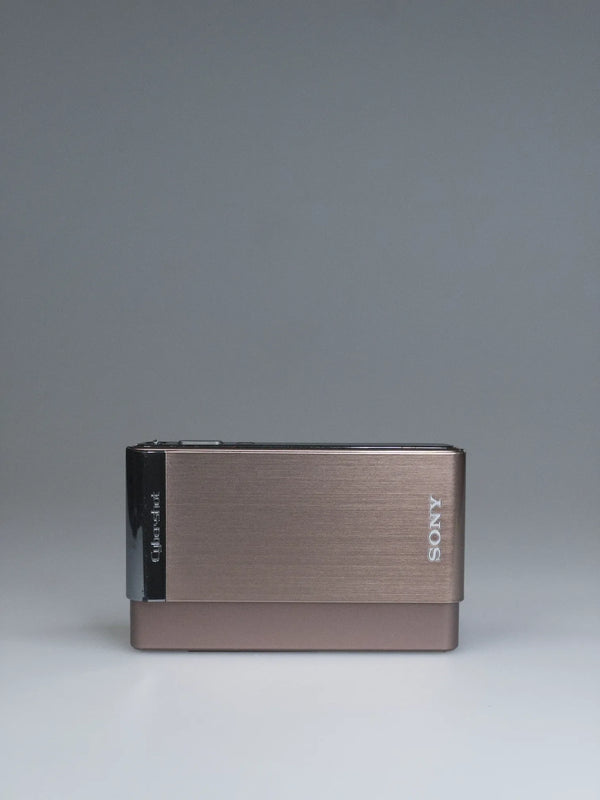
CCD: the Sony T70 and Panasonic FX30 from 2007, the Sony T90 from 2009, and the Nikon Coolpix S2900, which still had a CCD in 2015.
CMOS: the Sony WX100 with its back-illuminated sensor, and Canon's IXUS 285 HS and IXUS 500 HS.
SO SHOULD YOU BUY CCD OR CMOS?
Buy CCD if you want the classic flash-lit party look and you'll mostly shoot with the flash on. Buy back-illuminated CMOS if you want cleaner photos in dim light without flash. Either way, look at photos taken with that exact model before you decide. Our night-out guide has picks for both. Every camera we list is tested and checked before it goes up, and anything that isn't right is written into the condition notes.