Read the spec sheet like someone who's already been fooled by it
Guide · Basics · Updated November 2026
The numbers that matter most on a digicam are the zoom range in millimetres and the sensor size, not the megapixels. The "×" zoom figure tells you less than you'd think, and a lower f-number means a brighter lens. Here's how to read each one, with real examples from cameras we have now.
WHICH NUMBERS ON A DIGICAM ACTUALLY MATTER?
DO MORE MEGAPIXELS MEAN BETTER PHOTOS?
Not on their own. A digicam's sensor is tiny, and Sony's own explanation of its sensors puts the problem plainly: within a limited area, it's hard to have both a high pixel count and large pixels. More pixels give more detail, larger pixels cope better in the dark. Every camera picks a balance.
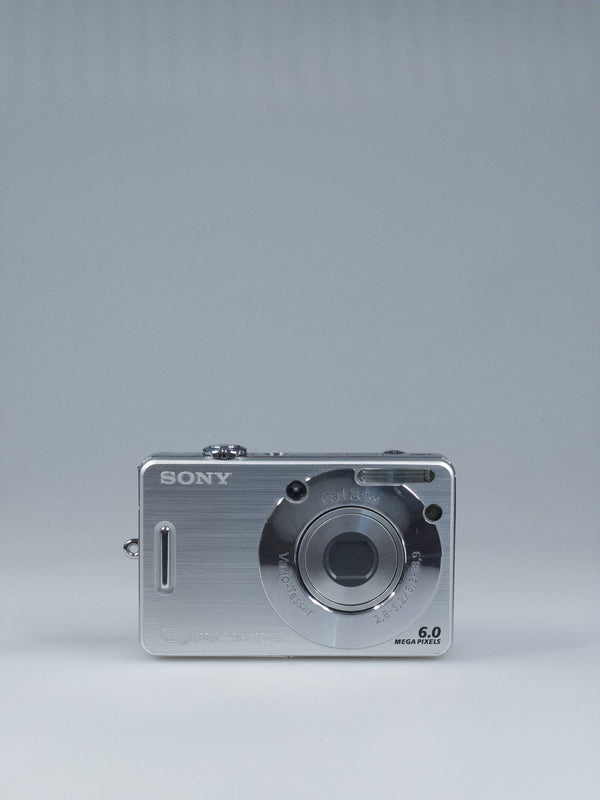
So a higher number doesn't make one camera the better buy. A 2006 Sony Cyber-shot W50 with 6MP and a 2012 Cyber-shot WX100 with 18.2MP also differ in sensor type, lens and processing, and their sample photos tell you more than the megapixel figure. Huge numbers on cheap new cameras are a separate trap, covered in our guide to cheap 4K cameras.
WHAT DOES 3× OPTICAL ZOOM MEAN?
It's the longest focal length divided by the shortest, nothing more. A lens that goes from 25mm to 100mm is a 4× zoom, because 100 ÷ 25 = 4. That means two cameras with the same "10×" can have quite different ranges. Neocamera's example is 25–250mm against 35–350mm, which is why the focal lengths tell you more than the × figure.
Some examples from our shelves:
- Canon IXUS 125 HS: 24–120mm, so 5×.
- Canon IXUS 500 HS: 28–336mm, so 12×.
- Canon PowerShot SX620 HS: 25–625mm, so 25×.
Ignore digital zoom completely. It doesn't move the lens. It just crops and enlarges the picture, which you can do later yourself.
WHAT DOES 28–105MM EQUIVALENT MEAN?
It tells you how the lens frames a scene, translated into the old 35mm film standard so different cameras can be compared. A digicam lens's real focal lengths are tiny because the sensor is tiny. Canon lists the IXUS 300 HS lens as 4.9–18.6mm, which it gives as about 28–105mm in 35mm terms. The equivalent figure is the one to compare.
- Wide end (24–28mm): the lower this number, the more you fit in. Good for group photos in small rooms.
- Long end (105mm, 300mm, 600mm): the higher this number, the closer you get to things far away.
Ricoh's own camera guide uses its GX200 as an example: only a 3× zoom, but starting at a wide 24mm, which suits snapshots in tight spaces.
WHAT DOES THE F-NUMBER MEAN?
It's how wide the lens opens, and it works backwards: a smaller number means a bigger opening and more light. Nikon describes a fast lens, one that opens very wide, as having a maximum aperture of f/2.8, f/2, f/1.8 or f/1.4. On a digicam you'll usually see two numbers, like f/2.8–5.9. The first is at the wide end, the second when you zoom all the way in, because compact zoom lenses let in less light as they zoom.
In practice: a lower first number means you can shoot indoors with less flash and less blur. Sony's W50 opens to f/2.8, and Canon's IXUS 300 HS to f/2.0.
WHAT DOES ISO MEAN ON A DIGICAM?
It's how much the camera amplifies the light it has. A higher ISO lets you take a photo in a darker place, but the picture gets grainier. If a camera lists ISO 3200 or 6400, expect the top settings to look noisy, and use the flash or a lower ISO when you can.
WHAT DOES 1/2.3-INCH SENSOR SIZE MEAN?
It's the sensor size, and it isn't really in inches. ITmedia's Japanese camera glossary explains that these figures come from old video camera tubes. A 1/2.3-inch sensor, the size in most compact digicams, has a diagonal of only about 7.7mm. The rule of thumb: the smaller the fraction, the bigger the sensor. A 1/1.7-inch sensor is bigger than a 1/2.3-inch one, and in 2012 ITmedia noted that Canon, Olympus and Nikon used 1/1.7-inch sensors in their high-end compacts while everyday models used 1/2.3-inch.
A bigger sensor generally gives smoother tones and less noise in the dark. Fujifilm's 2002 FinePix M603 has a 1/1.7-inch Super CCD, for example.
WHAT ABOUT THE OTHER NUMBERS?
- Screen size: 2.5-inch, 3-inch. Bigger is easier to judge photos on.
- Video: VGA, 720p or 1080. Our guide to how old your digicam should be shows when HD arrived.
- Year: the number that sums up all the others. The same guide shows what each year added.
WHAT SHOULD YOU REMEMBER ABOUT DIGICAM SPECS?
Look at the zoom range in millimetres, the first f-number and the sensor size. Treat megapixels and the × figure as rough guides, and ignore digital zoom. Then look at real photos from that exact camera: most of our listings have a "No filter" section shot on the camera itself. Every camera we list is tested and checked before it goes up, and anything that isn't right is written into the condition notes.