Pick the year by what you need, not by how old it looks
Guide · Basics · Updated November 2026
The oldest digicam worth buying depends on what you need it to do. For the classic flash look, any camera from about 2003 onwards is old enough. To avoid Memory Stick and xD cards, go for 2010 or later. For better photos in the dark and HD video, start at 2009–2010, and for Wi-Fi to your phone, 2012. Below is what each maker added, year by year, so you can see where your cut-off sits.
HOW OLD SHOULD YOUR DIGICAM BE?
IS THERE SUCH A THING AS A DIGICAM THAT'S TOO OLD?
For everyday use, yes: the very first ones. Casio's QV-10 from 1995 was the camera that put a screen on the back, but it recorded images at 320 × 240 pixels, about the size of a thumbnail today. The oldest cameras also use cards that are hard to find now. Mynavi's Japanese buying guide to old compacts notes that some take CompactFlash, and the oldest SmartMedia.
From about 2002–2003, compacts reach a few megapixels in properly designed pocket bodies, and that's where most people's search should start. Earlier cameras are for collectors who want the object as much as the photos.
WHAT CHANGED IN DIGICAMS YEAR BY YEAR?
1995: THE SCREEN ON THE BACK
Casio's QV-10, released in March 1995, was the first digital camera with an LCD monitor. You could see the photo straight away and delete the bad ones. Its 1/5-inch CCD had 250,000 pixels. Japan's DC Watch reports it sold 200,000 units a year, and Japan's National Museum of Nature and Science later registered it as a Future Technology Heritage item.
2000: THE DIGITAL IXUS
Canon put its digital technology into the body style of its tiny IXUS film cameras, and the first Digital IXUS arrived in 2000. It's sold as the IXY Digital in Japan and the PowerShot S100 Digital ELPH in North America. The design idea, a small metal box that fits in a shirt pocket, carried through the whole IXUS line. Our IXUS, ELPH and IXY guide explains the names.
2002: CARD-SIZED CAMERAS AND THE xD CARD
Casio went thin with the EX-S1, a card-sized camera that Casio says was the world's thinnest digicam at the time. Olympus and Fujifilm launched the xD-Picture Card in July 2002, the small card that would stay in their cameras until about 2009. Fujifilm's vertical FinePix M603 is from November 2002.
2003: STABILISATION AND THE SWIVEL BODIES
Panasonic's Lumix FX1 and FX5 were, in Panasonic's words, the world's first 3× zoom compacts with optical image stabilisation. It's the feature that cuts blur from shaky hands. Casio's thin EX-Z3 zoom became a worldwide hit. Canon's IXUS cameras moved from CompactFlash to SD between 2003 and 2004. It was also the year of odd shapes: Nikon's square swivelling Coolpix SQ and Kyocera's 15mm Finecam SL300R.
2004–2005: FACE DETECTION
Nikon introduced Face-priority AF in February 2005, calling it an industry first. It finds a face in the frame and focuses on it. Slim and strange designs kept coming: the splash-proof Olympus µ-mini Digital and the two-block Pentax Optio X in 2004, then Nikon's swivel Coolpix S4 and Konica Minolta's folded-zoom DiMAGE X1 in 2005.
2006: THE MEGAPIXEL RACE
Casio's EX-Z1000 was, according to Casio, the industry's first 10-megapixel compact. Screens got bigger too: Fujifilm's square FinePix V10 has a 3-inch screen and four built-in games.
2007: TOUCHSCREENS AND THE SMILE SHUTTER
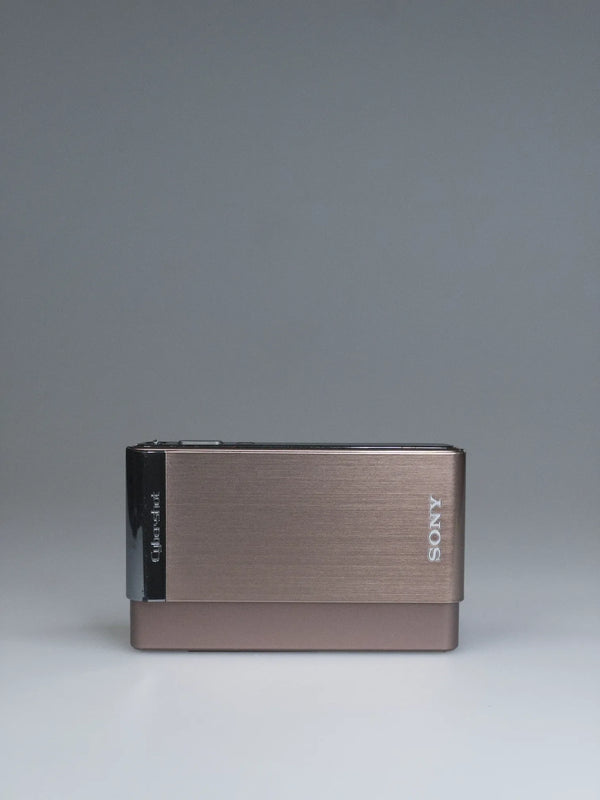
Sony's Cyber-shot T200 and T70 added Smile Shutter, which takes the photo by itself when someone smiles. Sony called it a first for digital photography. They were also the first Cyber-shots with a 16:9 touchscreen. According to the camera industry body CIPA, digital camera shipments passed 100 million that year for the first time.
2008: THE PEAK OF THE CCD COMPACT
CIPA counted almost 120 million digital cameras shipped in 2008, and about 110 million of them had a built-in lens. Most still used CCD sensors: Canon's IXUS cameras, for example, didn't switch to CMOS until 2010. This is the heart of the era people mean when they talk about the CCD look.
2009: BACK-ILLUMINATED SENSORS AND HD VIDEO
Sony's Cyber-shot TX1 and WX1 were the first stills cameras with a back-illuminated "Exmor R" CMOS sensor. Sony said it had about twice the sensitivity of conventional sensors, which means much better photos in dim rooms without flash. They also recorded 720p HD video, and so does the 13.9mm-thin Cyber-shot T90. The last Olympus cameras with xD cards came out in August 2009.
2010: SD EVERYWHERE, FULL HD AND THE ALL-TIME HIGH
Sony's 2010 Cyber-shots were its first compacts to take SD cards as well as Memory Stick. The W380 is one. Sony called its HX5V and TX7 the world's first compacts with Full HD AVCHD video, and the HX5V added GPS and a compass. Canon's IXUS 300 HS was the first IXUS with the HS System, a back-illuminated CMOS sensor for low light. Olympus moved its new compacts to SD. Digicam shipments reached their all-time high this year: CIPA counted around 121 million cameras.
2011–2012: SELFIE SCREENS AND WI-FI
Samsung's 2011 MV800 has a screen that flips up over the top for selfies. In 2012, the IXUS 510 HS and IXUS 240 HS were Canon's first cameras with built-in Wi-Fi, so you could send photos to a smartphone app. Canon's 19.2mm IXUS 500 HS and the 1080p IXUS 125 HS are from the same year.
2013 ONWARDS: THE PHONE TAKES OVER
Compacts fell away quickly. In the first five months of 2013, CIPA's compact shipments were down 42% on the year before. By 2023, CIPA members shipped just 1.7 million cameras with a built-in lens, compared with about 109 million in 2010. Some budget models kept CCD sensors to the end: Nikon's Coolpix S2900 had one in 2015, and Canon's IXUS 185 in 2017.
WHICH ERA SHOULD YOU START WITH?
- You want the classic look and don't mind quirks: 2003 to 2008. Real CCD colour and the boldest designs, but check the card type and battery first. Our memory card guide helps.
- You want the look but an easier life: 2009 to 2011. Many CCD models still around, SD cards in most cameras and 720p video.
- You shoot in dim bars without flash or want sharper video: 2010 onwards, ideally a back-illuminated CMOS camera. Our CCD vs CMOS guide explains the difference.
- You want to send photos straight to your phone: 2012 onwards with Wi-Fi, or any camera plus a card reader, as our photos to phone guide shows.
WHAT SHOULD YOU REMEMBER ABOUT A DIGICAM'S AGE?
Pick the year by the feature you can't live without, then choose the camera you like the look of from that point on. Older doesn't mean worse, it means more quirks to check: the card, the battery and the charger. If you're unsure, our guide to choosing your first digicam walks through the rest. Every camera we list is tested and checked before it goes up, and anything that isn't right is written into the condition notes.