Start with how you'll use it, not with the spec sheet
Guide · Buying guide · Updated November 2026
Choose your first digicam by what you'll shoot with it most, then make sure it arrives as a working kit: battery, charger and a memory card you can still buy. Sensor type and megapixels matter less than people think. Here's how to narrow it down without regretting it a week later.
WHAT SHOULD YOU DECIDE BEFORE YOU BUY A DIGICAM?
Decide where the camera will spend most of its time. That one answer picks most of the features for you:
WHICH DIGICAM SUITS WHAT YOU WANT TO SHOOT?
The one built for your most common situation, even if it's weaker at the rest. Some examples from what we have right now:
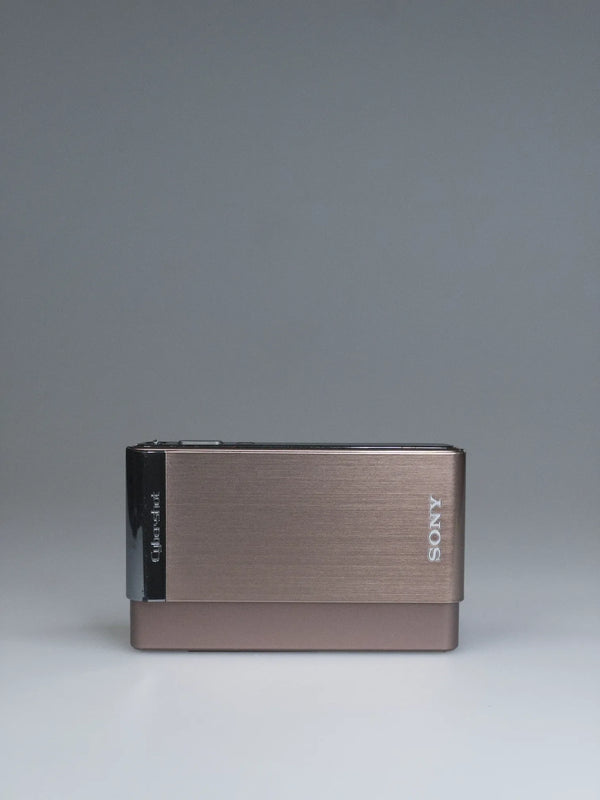
- Parties and bars. A slim camera with a direct flash, like Sony's 2007 Cyber-shot T70 with its sliding lens cover. Our night-out guide and flash look settings go deeper.
- Low light without flash. The 2012 Cyber-shot WX100 has an 18.2MP back-illuminated Exmor R sensor and a 10× zoom.
- Selfies. The 2011 Samsung MV800 has a 3-inch screen that flips up over the top so you can see yourself.
- Travel. Canon's 2016 PowerShot SX620 HS fits a 25× zoom into a pocket-sized body.
- Water, sand and snow. The 2009 Olympus µ TOUGH-6010 is waterproof, shockproof and freezeproof.
- Design first. Sony's T-series hides the lens behind a sliding cover and puts a touchscreen across the back. Read about the T77, or see Cyber-shots in stock.
SHOULD YOUR FIRST DIGICAM BE CCD OR CMOS?
Pick by how you'll shoot, not by the word on the box. If you'll mostly use the flash, a CCD camera gives you the classic look. If you want usable photos in dim rooms without flash, a back-illuminated CMOS camera copes better. Digital Camera World notes that CCD cameras look good in good light but struggle in low light, which is part of why the industry moved to CMOS.
The look also comes from the whole camera, not just the sensor: the colour processing, the small lens and the direct flash. Our CCD vs CMOS guide explains it, and the simplest test is to look at real photos from that exact model. Most of our listings have a "No filter" section with photos taken on the camera.
WHAT SHOULD YOU IGNORE ON THE SPEC SHEET?
Ignore digital zoom and don't chase megapixels. Digital zoom is just cropping, so only the optical zoom number tells you how close the lens really gets. The big megapixel and "4K" numbers on cheap new no-name cameras are mostly marketing, as our guide to cheap 4K cameras shows.
WHICH MEMORY CARD AND BATTERY WILL IT NEED?
Check both before you buy, because they're the most common hidden cost. Mynavi's Japanese buying guide to old compacts puts the card type and the maximum card size it supports at the top of its checklist. It also warns that used cameras are often sold without a battery, and that old cameras charge through their own charger or adapter, not a USB-C cable.
- The card. Most digicams take SD or SDHC, but older Sony cameras use Memory Stick Duo, and Fujifilm and Olympus used xD-Picture Card. Some older cameras also refuse newer, bigger cards. Our memory card guide shows which is which.
- The battery. Many digicams take a battery made for that brand or model, like Canon's NB-6L. Make sure one is included and still holds a charge, and see our batteries and chargers guide for replacements in Europe.
- Getting photos off it. A card reader is usually easiest. Memory Stick and xD need a reader that lists them. Our photos to phone guide covers the options.
Chinese tech site ifanr found the same thing when one of its editors bought a cheap CCD camera from the Xiaohongshu trend in 2022: it needed a new battery, a new card and a card reader before he could use it properly, and the card didn't fit his laptop's SD slot.
HOW DO YOU KNOW A USED DIGICAM ACTUALLY WORKS?
Someone has to use it, not just switch it on. Consumer Reports bought an old camera that powered up and took pictures, but its screen was dead, so there was no way to format the card, change a setting or get the photos off. Before you pay, check or ask the seller to check:
- The lens extends, zooms in and out smoothly and retracts. If it sticks, see our lens error guide.
- The screen shows a clear image with no dead areas or lines.
- The flash fires.
- The battery and card doors close and latch, and there's no corrosion on the battery contacts.
- It writes photos to a card and you can open them on a computer or phone.
- The listing photos show the actual camera, not a stock picture.
- The listing names the exact model, with the full regional name. Our IXUS, ELPH and IXY guide explains why that matters.
WHERE SHOULD YOU BUY YOUR FIRST DIGICAM?
From a seller who has tested it and will take it back if it's wrong. On Kleinanzeigen or eBay.de you'll often pay less, but a private seller can exclude the warranty, and there's no right of withdrawal when you buy from a private person. A dealer selling online has to give you both. For a first camera, a specialist used-camera shop is the safer start, especially one that shows photos of the actual camera and writes down its faults. Our guides to buying a used digicam in Germany and what a fair price includes go into the details.
That's how we run Bling Inc in Berlin. Every camera is tested before it's listed, faults go into the condition notes, and it ships with battery, charger, memory card and cable where they apply to the model. You get a one-year warranty and, in the EU, 14 days to change your mind. See what's in stock.
IS AN OLD DIGICAM WORTH IT IF YOU ALREADY HAVE A PHONE?
Yes, if you want the camera itself and not just a filter. The ifanr editor's conclusion was that an old CCD camera only makes sense if you like it as an object and accept its age, because an app can copy the colours. What an app can't copy is the flash, the zoom lens and a separate camera you take out for the moment.
WHAT SHOULD YOU REMEMBER WHEN CHOOSING YOUR FIRST DIGICAM?
Start with where you'll use it, then pick the features that serve that: flash for parties, back-illuminated CMOS for dim rooms, a flip screen for selfies, a long zoom for travel, a tough body for water. Check the card and battery before you buy, make sure someone has really tested it, and buy from a seller who will take it back if it's wrong. Every camera we list is tested and checked before it goes up, and anything that isn't right is written into the condition notes.